Vietnam orders provinces to introduce rooftop solar incentives by December 2026

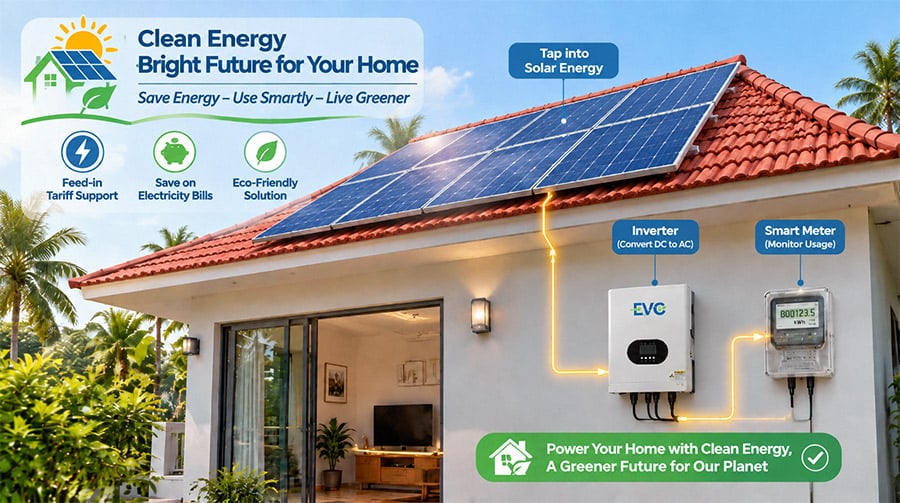
Vietnam’s government has ordered provincial and municipal authorities to introduce support policies for households installing rooftop solar systems for self-consumption by the end of December 2026. The instruction was issued under Government Office Dispatch No. 10790/VPCP-CN, dated Oct. 22, following a government meeting on electricity supply security and implementation of the revised Power Development Plan VIII (PDP8).
Prime Minister Le Minh Hung called for faster deployment of rooftop PV and battery energy storage systems (BESS) to reduce peak electricity demand and improve local energy self-sufficiency. Under the directive, the Ministry of Industry and Trade (MOIT) must propose rooftop solar deployment targets for individual provinces and cities by Oct. 30, with a particular focus on northern provinces where electricity supply constraints remain a concern. Implementation progress will be taken into account when assessing the performance of relevant ministries and local officials.
Provincial People’s Committees must introduce support policies for households investing in self-consumption rooftop PV systems by the end of December 2026, in line with Article 22 of Vietnam’s Electricity Law. The directive does not establish a nationwide subsidy rate, leaving local authorities to determine specific support mechanisms.
Energy storage is another priority. MOIT, in coordination with the ministries of finance and justice and other relevant agencies, must develop policies and guidance to accelerate BESS deployment by December 2026. The government is particularly encouraging rooftop PV paired with storage at industrial parks and industrial clusters, especially in northern Vietnam.
The latest instructions build on Directive No. 10/CT-TTg, issued in March 2026, which set targets for expanding rooftop solar deployment at households, government offices and commercial facilities, alongside electricity conservation and demand-side management measures. Vietnam has also eased restrictions on surplus rooftop solar generation. Decree No. 243/2026/ND-CP, which took effect on June 26, raised the standard limit on surplus electricity sales from 20% to 50% of eligible generation. Higher percentages may be negotiated until the end of 2030, subject to local grid capacity and operating conditions. The rules also allow eligible surplus electricity discharged from batteries charged by rooftop PV systems to be sold to the grid.
According to state-owned utility Vietnam Electricity (EVN), the country had 134,410 rooftop solar installations with a combined capacity of more than 11.45 GW at the end of August 2026. However, the rollout of local support measures has been slow. MOIT reported in September that only two of Vietnam’s 34 provinces and municipalities, Bac Ninh and Lai Chau, had adopted the required household support policies. The broader electricity security program also targets annual electricity savings of at least 3%, a reduction in consumption of at least 10% during peak summer months, and a cut in peak system demand of at least 3 GW.
As Vietnam’s provincial support policies take shape, distributors, installers and energy service providers will increasingly look for reliable PV-plus-storage solutions that can reduce peak demand, improve self-consumption and strengthen local energy resilience. That’s where EVCity comes in. We support overseas partners with scalable energy storage and electrical equipment designed for real-world deployment. From residential rooftops to commercial and industrial sites, our solutions help partners deliver safer, smarter and more efficient clean energy systems.