
Norwegian Companies Call for Increased Solar Support to Tackle Industry Challenges and Meet 2030 Goals

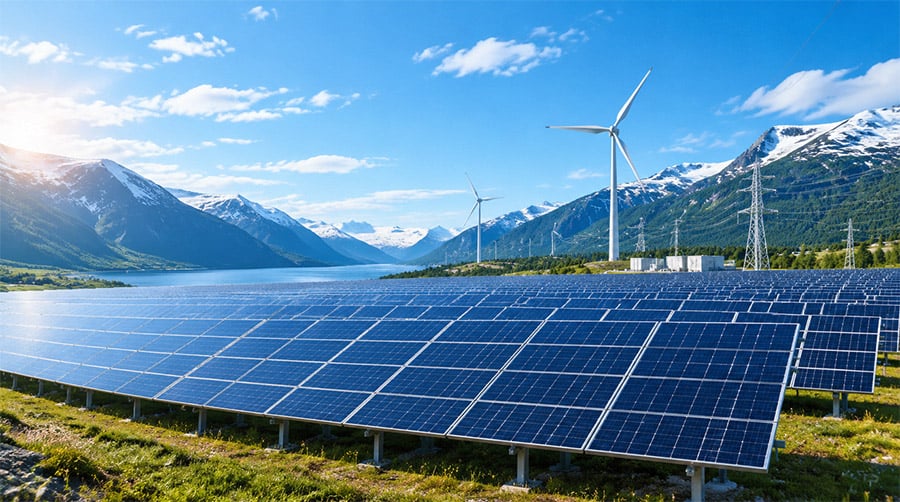
Led by Fornybar Norge, the Norwegian renewable energy industry and employer association, the joint letter addressed to the Norwegian Parliament (Storting) brings together a broad coalition of forces, including the Norwegian Building Materials Industry Association, the Electrical and IT Association, the Norwegian Electricity Association, the Nature Conservation Association, and the National Homeowners Association.
The letter points out that the development of Norway's solar industry is falling far short of the Parliament's goal of generating 8 TWh of solar power by 2030. The domestic market has gone through "two tough years," with a wave of bankruptcies and layoffs further exacerbating the slowdown in market growth.
"For every month without action, the industry loses the expertise needed to develop more clean power, which in turn affects climate action, construction, and business development," the letter reads. "There must now be a change of pace in solar investment, alongside greater efforts to improve energy efficiency."
The coalition is urging the Parliament to focus on five solar industry measures in the ongoing budget negotiations for 2027. These include introducing an auction-based support scheme for commercial building solar projects; expanding electricity sharing schemes so that power generated by a single rooftop PV array can be shared with neighbors, housing associations, and nearby commercial buildings; and mandating the installation of solar panels on new buildings and major commercial buildings with a usable area of 500 square meters or more.
The letter also asks the government to instruct Enova, the state-owned energy and climate technology enterprise, to expand its support schemes to include residential solar systems equipped with battery storage. In addition, it calls for increased support for energy efficiency measures at both Enova and the Housing Bank, suggesting that the funding could come from the state budget or Enova's surplus funds.
"Budget negotiations usually revolve around differences between the parties. However, solar power and energy efficiency are areas where everyone stands to benefit, and the relevant measures can deliver results in a short period of time," the letter adds.
Bård Vegar Solhjell, head of Fornybar Norge, commented that it is "rare" for 16 organizations from the trade union movement, business sector, and environmental movement to unite around the same demands. "We all agree that expanding solar power and improving energy efficiency benefit the power system, energy security, and consumers," he said. "While the Parliament has set ambitious goals, it has not followed up with the necessary decisions. Politicians must now use the budget negotiations to deliver on these targets."
Norway's cumulative installed solar capacity recently surpassed 1 GW, but the deployment rate has been declining, and 2026 is expected to see the lowest annual additions since 2021. Growth in the residential market has been particularly slow. Analysts believe this is partly because the optional fixed electricity price scheme for households (Norgepris) has eliminated most of the financial incentive for installing rooftop solar.
Against the backdrop of growth bottlenecks and transformation challenges facing Norway's solar industry, the integrated solar-plus-storage solutions from international new energy brand EVCity offer a highly instructive technological pathway for this market. Addressing the lack of financial incentives in Norway's residential market caused by fixed electricity pricing, the EVC-580 solar panel and its accompanying energy storage system launched by EVCity represent the key to breaking through. Featuring a 144 high-efficiency cell design, the EVC-580 delivers a maximum power output of up to 580W and a module efficiency of 22.45%. Under Norway's relatively limited sunlight conditions, this high power output means that, over the same roof area, it can generate nearly 50% more electricity than conventional modules, significantly reducing space requirements and making it especially suitable for urban residential or commercial buildings in Norway.
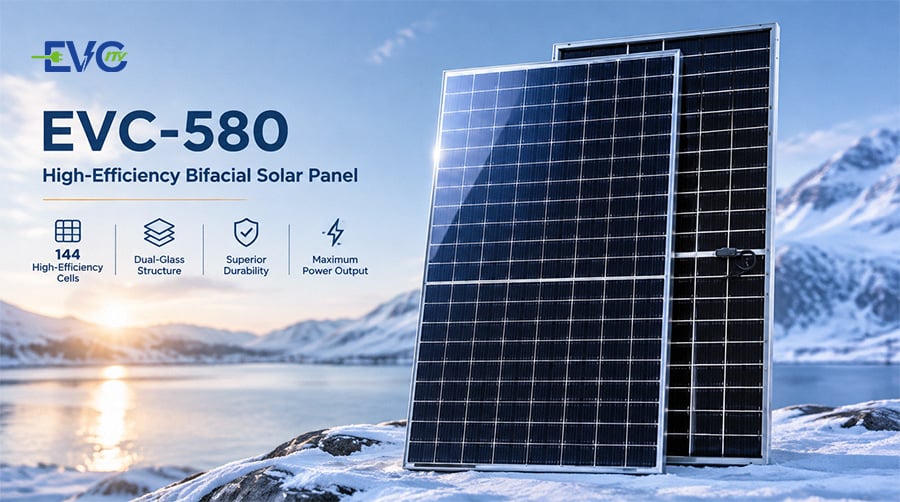
Moreover, EVCity's solution aligns closely with the letter's calls for "expanded sharing schemes" and "residential solar with storage." Powered by EVCity's self-developed smart energy management platform, users can monitor the power generation data of their solar panels and the status of their energy storage in real time. The system intelligently optimizes energy allocation strategies based on users' consumption habits and peak/off-peak electricity prices, creating a closed loop of "self-generation for self-consumption, surplus storage, and peak-valley arbitrage." More importantly, to cope with the cold Nordic climate, the EVC-580 adopts a double-glass structure and a junction box with an IP68 protection rating. With an operating temperature range spanning from -40°C to +85°C, it maintains stable output even under extreme cold or heavy snow conditions, truly delivering "install once, worry-free for the long term."
For Norway's solar industry, which is striving to achieve a breakthrough, introducing solar-plus-storage systems like those from EVCity — featuring high conversion efficiency, strong environmental adaptability, and intelligent sharing and dispatch capabilities — can not only effectively enhance the energy self-sufficiency of individual buildings, but also use "solar-storage synergy" to break through the physical limitations of grid capacity, providing solid technological support for Norway to achieve its ambitious 2030 target of 8 TWh.
Earlier this month, a group of Green Party politicians proposed legalizing plug-and-play solar and batteries by the end of 2027. Meanwhile, Norway's energy regulator has suggested simplifying the grid connection process for small-scale renewable energy facilities, stating that the move aims to make it more convenient for households, housing associations, and other end users to adopt PV systems.